

Call us at 630-780-1085, 404-504-7039, or 954-332-3513.
Insanity Defense | Criminal Responsibility Evaluations in Chicago, Atlanta, and Fort Lauderdale
Insanity Defense Psychological Evaluations by Dr. Steven Gaskell
Psycholegal Assessments, Inc. specializes in conducting comprehensive insanity defense psychological evaluations to assess a defendant's mental state at the time of an alleged offense. Serving clients in Illinois, Georgia, Florida, Arizona, Kansas, and beyond, we offer both in-person and secure, online HIPAA-compliant video assessments.
Dr. Steven Gaskell is a holder of the PSYPACT Authority to Practice Interjurisdictional Telepsychology (APIT) which allows him to provide insanity defense psychological evaluations by telehealth across 43 States.
Furthermore, Dr. Gaskell possesses the Temporary Authorization to Practice (TAP) credential which allows him to provide temporary in-person insanity defense evaluation services in any of the 43 PSYPACT states.
Contact US Today
Dr. Steven Gaskell - Forensic Psychologist

Insanity Defense
The insanity defense, also known as Not Guilty by Reason of Insanity (NGRI), is a legal doctrine asserting that a defendant was not criminally responsible for their actions due to a severe mental illness at the time of the offense. While this defense is raised in less than 1% of criminal cases, it underscores the importance of thorough psychological evaluations in the legal process.
Acquittal rates vary from state to state, but on average the insanity defense is only successful in approximately 25% of those attempts. Over 90% of NGRI findings are stipulated by both sides without a trial. Insanity acquittees spend on average more time in a secure mental hospital than they would have spent incarcerated if they had been convicted.
Criminal Responsibility - Insanity Evaluations
When a defendant’s mental state at the time they committed an offense is at question, a criminal responsibility psychological evaluation or sanity evaluation may be requested by the court, defense, or prosecution. Although the criteria for an insanity plea depends on the legal jurisdiction in which the crime was committed (see insanity tests below), the basis of an insanity plea rests on the basic premise that the defendant was not criminally responsible for their actions at the time of the offense due to the influence of a mental illness. Utilizing relevant legal statutes and case law, Psycholegal Assessments, Inc. utilizes psychological testing and evaluation to address the criteria necessary for an insanity plea.
When asked for an opinion about Criminal Responsibility, Sanity at the Time of the Offense, or the Insanity Defense, Dr. Steven Gaskell first determines by examination and review of records whether a defendant’s mental or emotional state at the time of the alleged offense meets the threshold requirement for a major mental disease or defect.
Dr. Gaskell then renders an opinion as to whether that condition substantially impaired the defendant’s ability to appreciate the wrongfulness of the criminal act for which he or she is accused, or whether the defendant’s mental condition substantially impaired his or her capacity to conform their conduct to the requirements of the law, or both.
In reports and expert testimony, Dr. Gaskell presents detailed evidence that the defendant’s clinical mental state either does or does not satisfy the legal definition of insanity. He also uses psychological testing, when appropriate, to evaluate the defendant for the possibility of feigning or malingering. Psychological examination reports address the psychological data in terms of the legal criteria regarding Criminal Responsibility or Sanity at the Time of the Offense in the jurisdiction of the evaluation. Dr. Gaskell has completed more than 700 Criminal Responsibility evaluations and he has provided expert testimony regarding sanity at the time of the offense. Dr. Steven Gaskell is currently licensed as a psychologist in Illinois, Georgia, Florida, Arizona, and Kansas.

Tests for Insanity
Courts in the United States use one of several established legal tests of insanity to determine whether someone was insane at the time of the offense. Insanity defense psychological evaluations utilize the appropriate test according to the jurisdiction. These tests for insanity are further described below.
M'Naghten Rule
The M’Naghten rule or standard provides that for an individual to be found Not Guilty By Reason of Insanity (NGRI), he or she must be “laboring under such a defect of reason, from disease of the mind, as not to know the nature and quality of the act he was doing; or if he knew it, that he did not know he was doing what was wrong.” The concept of disease of the mind excludes voluntary intoxication either by alcohol or drugs and strong emotional states.
ALI Model Penal Code
The American Law Institute (ALI) designed a new test for its Model Penal Code in 1962, in response to criticisms of the various tests for the insanity defense (including the Irresistible Impulse Test). Under the ALI Model Penal Code test (ALI Test), “a person is not responsible for criminal conduct if at the time of such conduct as a result of mental disease or defect he lacks substantial capacity either to appreciate the criminality of his conduct or to conform his conduct to the requirements of the law.”
The ALI Model Penal Code test is much broader than the M’Naghten Rule and the Irresistible Impulse Test. It asks whether defendants have a substantial incapacity to appreciate the criminality of their conduct or to conform their conduct to the law rather than the absolute knowledge required by M’Naghten and the absolute inability to control conduct required by the Irresistible Impulse Test.
The ALI Model Penal Code test also requires that the mental disease or defect be a mental diagnosis. In this way, it manages to incorporate elements of all three of its predecessors: the knowledge of right and wrong required by M’Naghten; the prerequisite of lack of control in the Irresistible Impulse Test; and the diagnosis of mental disease and defect required by Durham.
Such a broad based rule received wide acceptance, and by 1982 all federal courts and a majority of state courts had adopted the ALI test. While some states have since dropped the ALI test, and it no longer applies at the federal level, 18 states still use the ALI test in their definitions of insanity.
Irresistible Impulse Test
In 1887, the Irresistible Impulse Test was first adopted by the Alabama Supreme Court in the case of Parsons v. State. The Alabama court stated that even though the defendant could tell right from wrong, he was subject to “the duress of such mental disease [that] he had … lost the power to choose between right and wrong” and that “his free agency was at the time destroyed,” and thus, “the alleged crime was so connected with such mental disease, in the relation of cause and effect, as to have been the product of it solely.” In their finding, the court assigned responsibility for the crime to the mental illness despite the defendant’s ability to distinguish right from wrong. The Irresistible Impulse Test gained acceptance in various states as an addition to the M’Naghten Rule, under which right versus wrong was still considered a critical part of any definition of insanity. In some cases, the Irresistible Impulse Test was considered to be a variation on M’Naghten; in others, it was considered to be a separate test. Although the Irresistible Impulse Test was considered to be an important correction on the M’Naghten’s cognitive bias, it still came under criticism of its own. For example, it was criticized for making the definition of insanity too broad, failing to take into account the impossibility of determining which acts were uncontrollable rather than merely uncontrolled, and also making it easier to malinger or fake insanity. The Irresistible Impulse Test was also criticized for being too narrow; like M’Naghten, the test seemed to exclude all but those totally unable to control their actions. Nevertheless, several states currently use this test along with the M’Naghten Rule to determine insanity, and the American Law Institute in its Model Penal Code definition of insanity adopted a modified version of it.
Durham Standard
In Durham v. United States, the court ruled that a defendant is entitled to acquittal if the crime was the product of his mental illness (i.e., crime would not have been committed but for the disease). The Durham test, also called the Product Test, is broader than either the M’Naghten test or the Irresistible Impulse test. The Durham test has much more lenient guideline for the insanity defense, but it addressed the issue of convicting mentally ill defendants, which was allowed under the M’Naghten Rule. However, the Durham standard drew much criticism because of its expansive definition of legal insanity.
Insanity Defense Reform Act
The Insanity Defense Reform Act of 1984, signed into law on October 12, 1984, was the first comprehensive Federal legislation governing the insanity defense and the disposition of individuals suffering from a mental disease or defect who are involved in the criminal justice system. The more significant provisions:
- significantly modified the standard for insanity previously applied in the Federal courts;
- placed the burden of proof on the defendant to establish the defense by clear and convincing evidence;
- limited the scope of expert testimony on ultimate legal issues;
- eliminated the defense of diminished capacity;
- created a special verdict of “not guilty only by reason of insanity,” which triggers a commitment proceeding;
- provided for Federal commitment of persons who become insane after having been found guilty or while serving a Federal prison sentence.
Federal Standard Regarding the Insanity Defense
Federal Insanity Standard - United States Code - Title 18 - Part 1 - Chapter 1 - § 17
It is an affirmative defense to a prosecution under any Federal statute that, at the time of the commission of the acts constituting the offense, the defendant, as a result of a severe mental disease or defect, was unable to appreciate the nature and quality or the wrongfulness of his acts. Mental disease or defect does not otherwise constitute a defense. The defendant has the burden of proving the defense of insanity by clear and convincing evidence.
State Standards Regarding the Insanity Defense
Illinois
Illinois Complied Statutes 720 ILCS 5 Criminal Code of 1961. Section 6-2
A person is not criminally responsible for conduct if at the time of such conduct, as a result of mental disease or mental defect, he lacks substantial capacity to appreciate the criminality of his conduct.
A person who, at the time of the commission of a criminal offense, was not insane but was suffering from a mental illness, is not relieved of criminal responsibility for his conduct and may be found guilty but mentally ill.
For purposes of this Section, “mental illness” or “mentally ill” means a substantial disorder of thought, mood, or behavior which afflicted a person at the time of the commission of the offense and which impaired that person’s judgment, but not to the extent that he is unable to appreciate the wrongfulness of his behavior.Florida
Florida – Florida Statutes Title XLVI Crimes Section 775.01 – Insanity Defense
775.027 Insanity defense
(1) AFFIRMATIVE DEFENSE.—All persons are presumed to be sane. It is an affirmative defense to a criminal prosecution that, at the time of the commission of the acts constituting the offense, the defendant was insane. Insanity is established when:
(a) The defendant had a mental infirmity, disease, or defect; and
(b) Because of this condition, the defendant:
1. Did not know what he or she was doing or its consequences; or
2. Although the defendant knew what he or she was doing and its consequences, the defendant did not know that what he or she was doing was wrong.
Mental infirmity, disease, or defect does not constitute a defense of insanity except as provided in this subsection.
(2) BURDEN OF PROOF.—The defendant has the burden of proving the defense of insanity by clear and convincing evidence.
Georgia
Georgia Rule 31.5 Degree of Criminal Responsibility or Insanity at the Time of the Act.
Whether or not the accused had the mental capacity to distinguish right from wrong in relation to the alleged act; whether or not the presence of a delusional compulsion overmastered the accused’s will to resist committing the alleged act.
Arizona
Arizona Revised Statutes Title 13 Criminal Code 13-502 Insanity Test; Burden of Proof; Guilty Except Insane Verdict.
A. A person may be found guilty except insane if at the time of the commission of the criminal act the person was afflicted with a mental disease or defect of such severity that the person did not know the criminal act was wrong. A mental disease or defect constituting legal insanity is an affirmative defense. Mental disease or defect does not include disorders that result from acute voluntary intoxication or withdrawal from alcohol or drugs, character defects, psychosexual disorders or impulse control disorders. Conditions that do not constitute legal insanity include but are not limited to momentary, temporary conditions arising from the pressure of the circumstances, moral decadence, depravity or passion growing out of anger, jealousy, revenge, hatred or other motives in a person who does not suffer from a mental disease or defect or an abnormality that is manifested only by criminal conduct.
B. In a case involving the death or serious physical injury of or the threat of death or serious physical injury to another person, if a plea of insanity is made and the court determines that a reasonable basis exists to support the plea, the court may commit the defendant to a secure state mental health facility under the department of health services, a secure county mental health evaluation and treatment facility or another secure licensed mental health facility for up to thirty days for mental health evaluation and treatment. Experts at the mental health facility who are licensed pursuant to title 32, who are familiar with this state’s insanity statutes, who are specialists in mental diseases and defects and who are knowledgeable concerning insanity shall observe and evaluate the defendant. The expert or experts who examine the defendant shall submit a written report of the evaluation to the court, the defendant’s attorney and the prosecutor. The court shall order the defendant to pay the costs of the mental health facility to the clerk of the court. The clerk of the court shall transmit the reimbursements to the mental health facility for all of its costs. If the court finds the defendant is indigent or otherwise is unable to pay all or any of the costs, the court shall order the county to reimburse the mental health facility for the remainder of the costs. Notwithstanding section 36-545.02, the mental health facility may maintain the reimbursements. If the court does not commit the defendant to a secure state mental health facility, a secure county mental health evaluation and treatment facility or another secure licensed mental health facility, the court shall appoint an independent expert who is licensed pursuant to title 32, who is familiar with this state’s insanity statutes, who is a specialist in mental diseases and defects and who is knowledgeable concerning insanity to observe and evaluate the defendant. The expert who examines the defendant shall submit a written report of the evaluation to the court, the defendant’s attorney and the prosecutor. The court shall order the defendant to pay the costs of the services of the independent expert to the clerk of the court. The clerk of the court shall transmit the reimbursements to the expert. If the court finds the defendant is indigent or otherwise unable to pay all or any of the costs, the court shall order the county to reimburse the expert for the remainder of the costs. This subsection does not prohibit the defendant or this state from obtaining additional psychiatric examinations by other mental health experts who are licensed pursuant to title 32, who are familiar with this state’s insanity statutes, who are specialists in mental diseases and defects and who are knowledgeable concerning insanity.
C. The defendant shall prove the defendant’s legal insanity by clear and convincing evidence.
D. If the finder of fact finds the defendant guilty except insane, the court shall determine the sentence the defendant could have received pursuant to section 13-707 or section 13-751, subsection A or the presumptive sentence the defendant could have received pursuant to section 13-702, section 13-703, section 13-704, section 13-705, section 13-706, subsection A, section 13-710 or section 13-1406 if the defendant had not been found insane, and the judge shall sentence the defendant to a term of incarceration in the state department of corrections and shall order the defendant to be placed under the jurisdiction of the psychiatric security review board and committed to a state mental health facility under the department of health services pursuant to section 13-3994 for that term. In making this determination the court shall not consider the sentence enhancements for prior convictions under section 13-703 or 13-704. The court shall expressly identify each act that the defendant committed and separately find whether each act involved the death or physical injury of or a substantial threat of death or physical injury to another person.
E. A guilty except insane verdict is not a criminal conviction for sentencing enhancement purposes under section 13-703 or 13-704.
California
California Penal Code Section 25 – Not Guilty By Reason of Insanity
(a) The defense of diminished capacity is hereby abolished. In a criminal action, as well as any juvenile court proceeding, evidence concerning an accused person’s intoxication, trauma, mental illness, disease, or defect shall not be admissible to show or negate capacity to form the particular purpose, intent, motive, malice aforethought, knowledge, or other mental state required for the commission of the crime charged. (b) In any criminal proceeding, including any juvenile court proceeding, in which a plea of not guilty by reason of insanity is entered, this defense shall be found by the trier of fact only when the accused person proves by a preponderance of the evidence that he or she was incapable of knowing or understanding the nature and quality of his or her act and of distinguishing right from wrong at the time of the commission of the offense. (c) Notwithstanding the foregoing, evidence of diminished capacity or of a mental disorder may be considered by the court only at the time of sentencing or other disposition or commitment.
Colorado
Colorado SECTION 2. Article 8 of title 16, Colorado Revised Statutes, 1986
16-8-101.5. Insanity defined – offenses committed on and after July 1, 1995. (1) The applicable test of insanity shall be:
(a) A person who is so diseased or defective in mind at the time of the commission of the act as to be incapable of distinguishing right from wrong with respect to that act is not accountable; except that care should be taken not to confuse such mental disease or defect with moral obliquity, mental depravity, or passion growing out of anger, revenge, hatred, or other motives and kindred evil conditions, for, when the act is induced by any of these causes, the person is accountable to the law; or
(b) A person who suffered from a condition of mind caused by mental disease or defect that prevented the person from forming a culpable mental state that is an essential element of a crime charged, but care should be taken not to confuse such mental disease or defect with moral obliquity, mental depravity, or passion growing out of anger, revenge, hatred, or other motives and kindred evil conditions because, when the act is induced by any of these causes, the person is accountable to the law.
(2) As used in subsection (1) of this section:
(a) “Diseased or defective in mind” does not refer to an abnormality manifested only by repeated criminal or otherwise antisocial conduct.
(b) “Mental disease or defect” includes only those severely abnormal mental conditions that grossly and demonstrably impair a person’s perception or understanding of reality and that are not attributable to the voluntary ingestion of alcohol or any other psychoactive substance but does not include an abnormality manifested only by repeated criminal or otherwise antisocial conduct.
(3) This section shall apply to offenses committed on or after July 1, 1995.
Iowa
Iowa 2005 – Code 701.4 – Insanity
Indicates that “A person shall not be convicted of a crime if at the time the crime is committed the person suffers from such a diseased or deranged condition of the mind as to render the person incapable of knowing the nature and quality of the act the person is committing or incapable of distinguishing between right and wrong in relation to that act. Insanity need not exist for any specific length of time before or after the commission of the alleged criminal act. If the defense of insanity is raised, the defendant must prove by a preponderance of the evidence that the defendant at the time of the crime suffered from such a deranged condition of the mind as to render the defendant incapable of knowing the nature and quality of the act the defendant was committing or was incapable of distinguishing between right and wrong in relation to the act.”
Michigan
Michigan Code of Criminal Procedure Act – 768.21a Persons deemed legally insane
Sec. 21a.
(1) It is an affirmative defense to a prosecution for a criminal offense that the defendant was legally insane when he or she committed the acts constituting the offense. An individual is legally insane if, as a result of mental illness as defined in section 400a of the mental health code, Act No. 258 of the Public Acts of 1974, being section 330.1400a of the Michigan Compiled Laws, or as a result of being mentally retarded as defined in section 500(h) of the mental health code, Act No. 258 of the Public Acts of 1974, being section 330.1500 of the Michigan Compiled Laws, that person lacks substantial capacity either to appreciate the nature and quality or the wrongfulness of his or her conduct or to conform his or her conduct to the requirements of the law. Mental illness or being mentally retarded does not otherwise constitute a defense of legal insanity.
(2) An individual who was under the influence of voluntarily consumed or injected alcohol or controlled substances at the time of his or her alleged offense is not considered to have been legally insane solely because of being under the influence of the alcohol or controlled substances.
(3) The defendant has the burden of proving the defense of insanity by a preponderance of the evidence.
New York
New York Code Section 40.15 – Mental Disease or Defect
§ 40.15 Mental disease or defect.
In any prosecution for an offense, it is an affirmative defense that when the defendant engaged in the proscribed conduct, he lacked criminal responsibility by reason of mental disease or defect. Such lack of criminal responsibility means that at the time of such conduct, as a result of mental disease or defect, he lacked substantial capacity to know or appreciate either:
1. The nature and consequences of such conduct; or
2. That such conduct was wrong.
North Carolina
North Carolina SUBCHAPTER X. GENERAL TRIAL PROCEDURE. Article 56.
Incapacity to Proceed – Competency to Stand Trial.
§ 15A-1001. No proceedings when defendant mentally incapacitated; exception.
(a) No person may be tried, convicted, sentenced, or punished for a crime when by reason of mental illness or defect he is unable to understand the nature and object of the proceedings against him, to comprehend his own situation in reference to the proceedings, or to assist in his defense in a rational or reasonable manner. This condition is hereinafter referred to as “incapacity to proceed.”
(b) This section does not prevent the court from going forward with any motions which can be handled by counsel without the assistance of the defendant. (1973, c. 1286, s. 1.
§ 15A-1002. Determination of incapacity to proceed (competency to stand trial); evidence; temporary commitment; temporary orders.
(a) The question of the capacity of the defendant to proceed (e.g., issue of competency to stand trial) may be raised at any time on motion by the prosecutor, the defendant, the defense counsel, or the court. The motion shall detail the specific conduct that leads the moving party to question the defendant’s capacity to proceed or competency to stand trial.
(b) When the capacity of the defendant to proceed (e.g., issue of competency to stand trial) is questioned, the court shall hold a hearing to determine the defendant’s capacity to proceed. If an examination is ordered pursuant to subdivision (1) or (2) of this subsection, the hearing shall be held after the examination. Reasonable notice shall be given to the defendant and prosecutor, and the State and the defendant may introduce evidence. The court:
(1) May appoint one or more impartial medical experts, including forensic evaluators approved under rules of the Commission for Mental Health, Developmental Disabilities, and Substance Abuse Services, to examine the defendant and return a written report describing the present state of the defendant’s mental health; reports so prepared are admissible at the hearing and the court may call any expert so appointed to testify at the hearing; any expert so appointed may be called to testify at the hearing by the court at the request of either party; or
(2) In the case of a defendant charged with a misdemeanor only after the examination pursuant to subsection (b)(1) of this section or at any time in the case of a defendant charged with a felony, may order the defendant to a State facility for the mentally ill for observation and treatment for the period, not to exceed 60 days, necessary to determine the defendant’s capacity to proceed; in the case of a defendant charged with a felony, if a defendant is ordered to a State facility without first having an examination pursuant to subsection (b)(1) of this section, the judge shall make a finding that an examination pursuant to this subsection would be more appropriate to determine the defendant’s capacity; the sheriff shall return the defendant to the county when notified that the evaluation has been completed; the director of the facility shall direct his report on defendant’s condition to the defense attorney and to the clerk of superior court, who shall bring it to the attention of the court; the report is admissible at the hearing.
Ohio
Ohio Chapter 2945 – 295.371 G-4 – Not Guilty by Reason of Insanity
If the evaluation was ordered to determine the defendant’s mental condition at the time of the offense charged, the examiner’s findings as to whether the defendant, at the time of the offense charged, did not know, as a result of a severe mental disease or defect, the wrongfulness of the defendant’s acts charged.
Pennsylvania
Pennsylvania Section 315 of the Crimes Code –
315 (a) The mental soundness of an actor engaged in conduct charged to constitute an offense shall only be a defense to the charged offense when the actor proves by a preponderance of the evidence that the actor was legally insane at the time of the commission of the offense.
315 (b) Legally Insane means that, at the time of the commission of the offense, the actor was laboring under such a defect of reason, from a disease of the mind, as not to know the nature and quality of the act he was doing, or, if the actor did know the quality of the act, that he did not know what he was doing was wrong.
Tennessee
Tennessee Title 39 Mental Status at Time of Alleged Offense
Insanity Defense Definition from Tennessee Code Annotated T.C.A. § 39-11-501. “Insanity
- (a) It is an affirmative defense to prosecution that, at the time of the commission of the acts constituting the offense, the defendant, as a result of a severe mental disease or defect, was unable to appreciate the nature or wrongfulness of such defendant’s acts. Mental disease or defect does not otherwise constitute a defense. The defendant has the burden of proving the defense of insanity by clear and convincing evidence.
- (b) As used in this section, “mental disease or defect” does not include any abnormality manifested only by repeated criminal or otherwise antisocial conduct.
- (c) No expert witness may testify as to whether the defendant was or was not insane as set forth in subsection (a). Such ultimate issue is a matter for the trier of fact alone.
“Wrongfulness” is commonly understood to encompass both moral and legal wrongfulness (Kelley v. State, 2005 Tenn. Crim. App.). A jury is justified in finding that a defendant appreciated the wrongfulness of his actions if there was evidence to show that the defendant appreciated either that the act was legally wrong or morally wrong.
Texas
Texas Section 8.01 and Article 46
(a) It is an affirmative defense to prosecution that at the time of the conduct charged, the actor, as a result of a severe mental disease or defect, did not know that his conduct was wrong.
(b) The term “mental disease or defect” does not include an abnormality manifested only by repeated criminal or otherwise antisocial conduct.
Art. 46C.002. MAXIMUM PERIOD OF COMMITMENT DETERMINED BY MAXIMUM TERM FOR OFFENSE.
(a) A person acquitted by reason of insanity may not be committed to a mental hospital or other inpatient or residential care facility or ordered to receive outpatient or community-based treatment and supervision under Subchapter F for a cumulative period that exceeds the maximum term provided by law for the offense for which the acquitted person was tried.
(b) On expiration of that maximum term, the acquitted person may be further confined in a mental hospital or other inpatient or residential care facility or ordered to receive outpatient or community-based treatment and supervision only under civil commitment proceedings.Diminished Capacity
(a)The defense of diminished capacity is hereby abolished. In a criminal action, as well as any juvenile court proceeding, evidence concerning an accused person’s intoxication, trauma, mental illness, disease, or defect shall not be admissible to show or negate capacity to form the particular purpose, intent, motive, malice aforethought, knowledge, or other mental state required for the commission of the crime charged.
(b)In any criminal proceeding, including any juvenile court proceeding, in which a plea of not guilty by reason of insanity is entered, this defense shall be found by the trier of fact only when the accused person proves by a preponderance of the evidence that he or she was incapable of knowing or understanding the nature and quality of his or her act and of distinguishing right from wrong at the time of the commission of the offense.
(c)Notwithstanding the foregoing, evidence of diminished capacity or of a mental disorder may be considered by the court only at the time of sentencing or other disposition or commitment.
(d)The provisions of this section shall not be amended by the Legislature except by statute passed in each house by rollcall vote entered in the journal, two-thirds of the membership concurring, or by a statute that becomes effective only when approved by the electors.
Wisconsin
Wisconsin Chapter 971.15 – Mental Responsibility of Defendant
A person is not responsible for criminal conduct if at the time of such conduct as a result of mental disease or defect the person lacked substantial capacity either to appreciate the wrongfulness of his or her conduct or conform his or her conduct to the requirements of law.
Quick guide
Status of the Insanity Defense Among States
1. M’Naghten Rule (Standard Only)
Burden of proof on defendant unless noted
Burden on Defendant
- Alabama
- Alaska (GBMI allowed)
- Arizona
- California
- Delaware (GBMI allowed)
- Indiana (GBMI allowed)
- Iowa
- Louisiana
- Minnesota
- Missouri
- Nebraska
- Nevada
- New York (modified)
- North Carolina
- Pennsylvania (GBMI allowed)
- South Carolina (GBMI allowed)
- South Dakota (GBMI allowed)
- Virginia (with irresistible impulse)
- Washington
Burden on State
- Florida
- Mississippi
- New Jersey
- Oklahoma
2. M’Naghten Rule + Irresistible Impulse Test
Burden of proof on defendant unless noted
Burden on Defendant
- Georgia (GBMI allowed)
- Texas
Burden on State
- Colorado
- New Mexico (GBMI allowed)
3. ALI Model Penal Code Standard
Burden on Defendant
- Arkansas
- Connecticut
- District of Columbia
- Hawaii
- Illinois (GBMI allowed)
- Kentucky (GBMI allowed)
- Maine
- Maryland
- Ohio
- Oregon
- Rhode Island
- Vermont
- Wisconsin
- Wyoming
Burden on State
- Massachusetts
- Michigan (GBMI allowed)
- North Dakota (modified)
- Tennessee
- West Virginia
4. Other / Unique Standards
Durham Standard
- New Hampshire (burden on defendant)
5. States That Abolished the Insanity Defense
- Idaho
- Kansas
- Montana (GBMI allowed)
- Utah (GBMI allowed)
6. States Allowing “Guilty but Mentally Ill (GBMI)” Verdicts
(Across all rule types)
- Alaska
- Delaware
- Georgia
- Illinois
- Indiana
- Kentucky
- Michigan
- Montana
- New Mexico
- Pennsylvania
- South Carolina
- South Dakota
- Utah
State Standards Regarding the Insanity Defense
Durham v. U.S. (D.C. Circuit Court of Appeals, 1954)
During this case, the Appellate Court formulated a new test for criminal responsibility (insanity): An accused is not criminally responsible of his unlawful act was the product of a mental disease or defect. This was later termed the Product Rule or Durham Rule.
McDonald v. U.S.
The court chose to define mental disease or defect which was previously left undefined in the Durham decision. The court held that “Mental disease or defect includes any abnormal condition of the mind which substantially affects mental or emotional processes and substantially impairs behavior controls.”.
Frendak v. U.S.
The court found that the insanity defense may not be forced on a defendant found competent to stand trial if the defendant intelligently and voluntarily, forgoes that defense.
Ake v. Oklahoma
The court found that the State must provide an indigent defendant with psychiatric assistance in preparing an insanity defense if the defendant’s sanity at the time of the crime is in question. The court also ruled that certain death penalty defendants have a separate right to psychiatric help. When the State seeks the death penalty on the ground that the defendant presents a danger to society, an indigent defendant is constitutionally entitled to psychiatric assistance in rebutting that assertion.
Foucha v. Louisiana
The court found that and expert cannot testify to the Ultimate Question. It should be noted that this was a minority opinion, and most courts want full testimony, as long as it is logical and explained. The finding was that psychiatric/psychological experts may not speak directly in terms of product, result or cause. They should only explain how the defendant’s mental illness may have influenced his conduct. Experts were prohibited from addressing the ultimate issue in insanity cases. It should be noted that most states do not prohibit ultimate issue testimony in insanity cases.
Wilson v. U.S North Carolina v. Alford
This ruling gave the judge guidelines on how to evaluate if a person with amnesia has had a fair trial. It was ruled that amnesia alone does not render a defendant incompetent to stand trial. Factors to be considered in determining competency of an amnestic defendant include the extent to which the amnesia affects the defendant’s ability to: (1) Assist counsel; (2) Testify on his own behalf; and (3) Extrinsically reconstruct the events of a case. Other considerations included; (1) The strength of the State’s case; (2) The extent to which the State assisted in the extrinsic reconstruction of events; and (3) Any other facts or circumstances which would indicate whether or not the defendant had a fair trial.
Foucha v. Louisiana
The court held that an insanity acquittee may not be held unless he is both mentally ill and dangerous.
Rouse v. Cameron
The court found that a patient committed as not guilty by reason of insanity (NGRI) must either get treatment or be released, unless such release would present a real social menace.
Jones v. U.S.
The court held that the Constitution permits the government to confine an NGRI acquittee to a mental institution until such time as he has regained his sanity or is no longer a danger to himself or others.
U.S. v. Torniero
The court upheld the exclusion of expert testimony regarding pathological gambling as not being relevant to the ability to refrain from the criminal act of theft, but it left open the possibility that it could be a defense for a gambling crime.
State v. Rodriquez
The court ruled on whether Dissociative Identity Disorder (also referred to as Multiple Personality Disorder) could be used as a basis for an NGRI defense. The ruling stated, “It is immaterial whether the defendant was in one state of consciousness or another, so long as in the personality then controlling the behavior, the defendant was conscious and his actions were the product of his own volition.”
Kirkland v. State
The court also ruled on whether Dissociative Identity Disorder (also referred to as Multiple Personality Disorder) could be used as a basis for an NGRI defense. The court held that “The core personality is held strictly accountable for the acts committed by a secondary personality, as long as that personality possessed the requisite sanity.”
Areas of Expertise
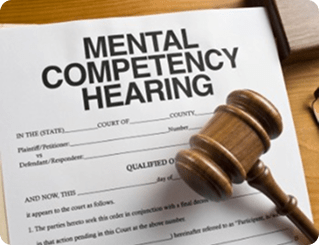 Competency to Stand Trial
Competency to Stand Trial, also known as Fitness to Stand Trial, is imperative for ensuring that a defendant can comprehend the nature and objective of the legal actions against them and actively cooperate with their defense attorney.
 Psychosexual Evaluations
Psychosexual evaluations of sex offenders incorporate a comprehensive risk assessment utilizing actuarial instruments and other research-supported risk and protective factors.
 Criminal Responsibility
Criminal responsibility or sanity evaluations are critical when a defendant’s mental state at the time of committing an offense is in question. These evaluations can be initiated by the court, defense, or prosecution to establish a clear understanding of the defendant’s mental condition during the crime.
 Independent Medical Exam
An Independent Medical Exam is conducted by a psychologist without prior involvement in the individual’s care, ensuring an objective assessment without a therapist-patient relationship.
 Miranda Rights & Confession Issues
The role of confessions and self-incriminating statements in criminal cases cannot be understated. Confessions are produced in about 50% of criminal cases, where suspects who provide self-incriminating statements are 26% more likely to be found guilty and convicted (Leo, 2006).
 Malingering and Deception
In the legal realm, psychological assessments can be compromised by malingering or deception, with individuals potentially presenting themselves dishonestly during interviews and tests to influence the outcome.
 Mitigating Factors
Mitigating factors consider the defendant’s mental state and historical mental disorders or psychological trauma, even when these do not qualify for an insanity defense, to argue for a reduced sentence. The contributions of evaluations and reports by experts like Dr. Steven Gaskell are vital for presenting such evidence.
 Guilty But Mentally Ill (GBMI)
Introduced first in Michigan in 1975, the GBMI verdict was proposed to diminish the success rate of insanity defenses, offering a compromise verdict that, while seemingly compassionate, subjects the defendant to the same penalties as a guilty verdict.
Video Conferencing Available!
Schedule your free video consultation today. HIPAA-compliant evaluations available across multiple states.
Video Conferencing Available!
Psychological evaluations are now able to be completed by HIPAA compliant video conferencing.
Request more details by filling out the form below.
Video Conferencing Available!
Psychological evaluations are now able to be completed by HIPAA compliant video conferencing.
Request more details by filling out the form below.